
26. Dr. Shreya Soni, Endometriosis Expert on Advocating for Your Health
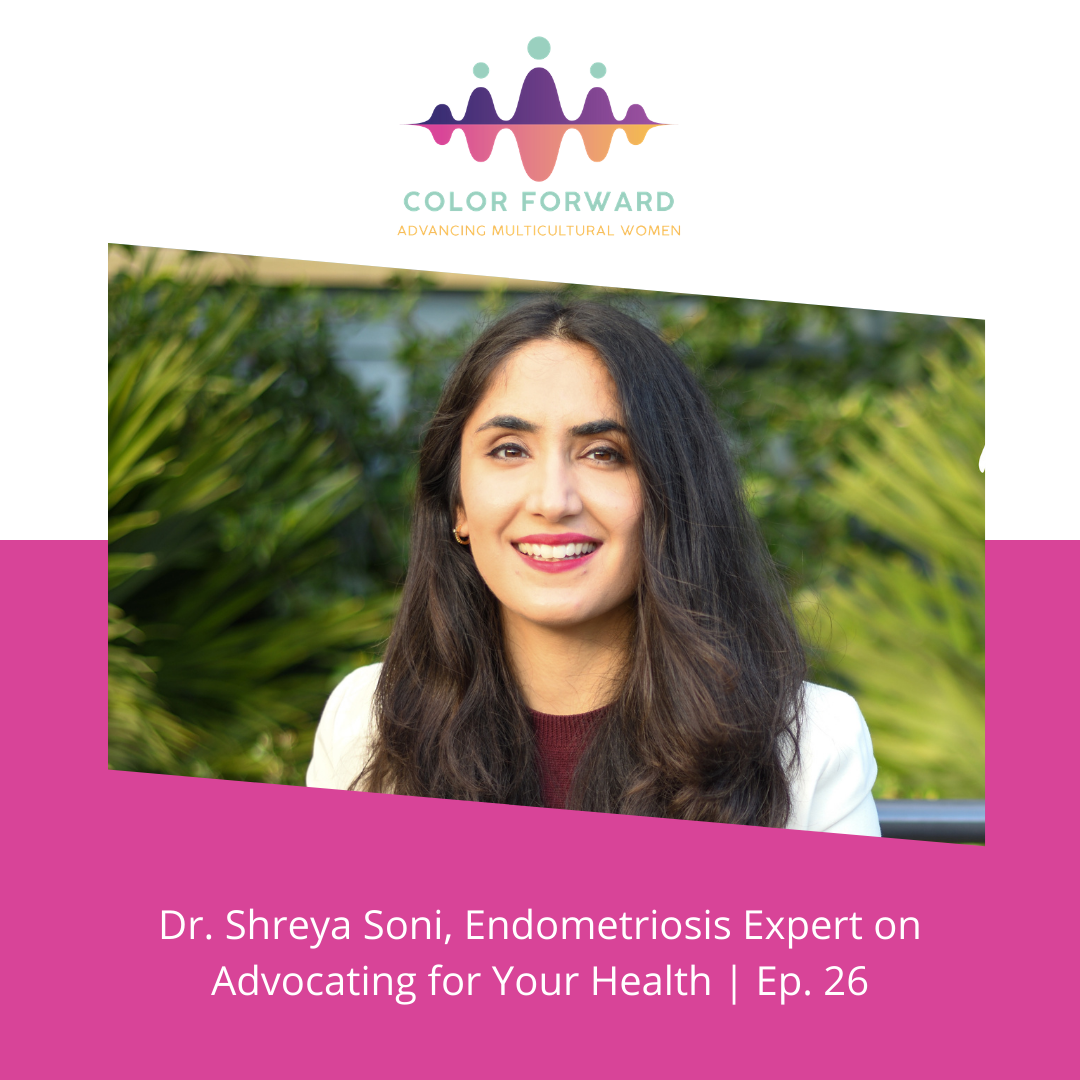
Dr. Shreya Soni knows the power of listening to your body and advocates for better health by encouraging women to ask more of their doctors. Listen as she shares with Alisa, Rosa, and Merary about the importance of preventative healthcare and supporting ourselves all the time.
Ep 26. Transcript
[intro theme]
Alisa Manjarrez: Rosa and Merary, Ive been thinking a lot about the idea of listening to your body, and I feel like I’m better now, but it wasn’t until I had a friend who had a chronic illness who taught me the power of listening to her body. She didn’t have a choice. She was in pain for two years, and now that she’s pain free, she has to listen in order to not go back into that pain. Our guest today…
Dr. Shreya Soni: I’m Dr. Shreya Soni, and I’m a naturopathic doctor.
Alisa Manjarrez: She’s lived around the world and has been exposed to various types of health systems and treatments.
Dr. Shreya Soni: I focus in supporting women, especially with endometriosis. It’s a condition in which cells that are typically in the uterine cavity are found in other parts of the body. It can be your low back. It can be your esophagus. It can even be in your brain. And so every month when these women are having their periods, they’re in this debilitating pain. It can come along with nausea. They often have trips to the ER as well, just because of that monthly menstrual pain.
Alisa Manjarrez: She’s lived around the world and has been exposed to various types of health systems and treatments because of it. And what I like about her approach to medicine is that she brings her Indian culture, the culture of other places around the world that she’s lived and modern Western medicine and having parents that really advocated for her to get the education and experiences that she needs. The idea that her parents advocated for her to both get education and cultural experience really informed her practice today.
Dr. Shreya Soni: I have had quite a diverse childhood and background. I was born in New Delhi, India. And I spent a lot of time as well in Bahrain, which is this Island country in the Arabian Gulf. And around 2000, my parents tried to move over to the US. So we started out in California that moved to Virginia, and their only reason for moving around this much growing up was to get me and my sister a good education. They wanted to be with us eventually when we would go to college and they wanted to be in a country where they could still be near us for that. So throughout this experience, growing up in multiple different countries, I’ve had the chance to learn about different traditional medicines.
So in New Delhi ayurveda is quite popular, so is homeopathy and there’s plenty of acupuncture there as well. So growing up, I always had this integrated into my toolbox.
Alisa Manjarrez: Her mom was a huge part of that, because she helped her understand her body and accept her body, and I think Rosa, you talking about your mom really drilling in you that it’s important to take care of yourself. She was advocating for you as a young woman. And Dr. Soni’s mom did the same thing, and in her version of advocating was helping Dr. Soni accept her differences.
Dr. Shreya Soni: I would say I’m blessed in that I had a strong mom who always kind of said, it’s okay to be different. It’s okay to love your arm hair, you know, you don’t need to shave anything if you don’t want to.
Rosa Santos: I remember growing up there were a couple of girls in my school that were anorexic, and it was very hard to see these woman, these young woman at the time, I was one of them wanting to conform to an idea of beauty that was unattainable to the point that they were… I’m not saying they were willing to die, but put their health in a position that was very, um, borderline. And one of them passed away. Yeah, I still remember it. I still remember so vividly. What happens to us women to get to that point?
And I know that it might not be the comparison because at the end of the day, that is ends up being a mental health illness. It may not be anorexia. It might be little things that we might do or not do that will compromise our overall health. And those things are again, because I think they are certain morals or roles or expectations that lead you to maybe not taking care of yourself the way you should.
Dr. Shreya Soni: Even with pain as women there’s a stigma about talking about your period because you want to be seen as equal to, so just because of your period, it doesn’t mean it’s going to affect your work for example. In fact, I don’t think it does at all. My patients with endometriosis run their own businesses, have large families. They’re some of the smartest, most successful women that I know, but some people do have this belief that admitting that you have a healthcare issue itself is a challenge.
Rosa Santos: Raising concerns about certain pains that you may have because of what others might think, that you are a whiner or that you complain, or even how you might be viewed by the doctor about something that, you know, there may be a huge bias. It doesn’t matter the age, and that’s, what for me, what we need to talk about, we need to talk about it’s okay. It probably is nothing, but better, safe than sorry. And it is okay to share. It’s okay to go search for information. It’s okay to buck your doctor. It’s okay. There’s a lot of wrong in our society that pushes women specially to behave in certain ways, collectively that it’s not acceptable.
That is not good for us. And especially for certain women, and as Dr. Soni talks about, especially women of color still today suffer from major pitfalls of the system and overlooking them, right, overlooking us.
Dr. Shreya Soni: In my environmental medicine studies I’ve seen presentations on how, when you’re trying to fit a Caucasian narrative of beauty of straight hair or light skin, you’re more likely to use products that have chemicals that increase your exposure to endocrine, which means hormone disrupting toxins, and so your burden is higher. So those are just a few of it. And then, the socioeconomic piece can factor into what you’re eating, whether you’re going to get that organic food in the grocery store, or you’re compromising, with some of the processed foods that’s going to change, your internal health, but I think a big part of it is being dismissed by the healthcare system as a minority. And when it comes to patients, it’s me repairing that relationship with their bodies, reminding them that their bodies are capable of healing, that their bodies are powerful and supporting them. So oftentimes pain is an expression and it has to be heard.
Merary Simeon: Yeah, I was reading somewhere that many times we are actually thinking what the culture wants us to think instead of paying attention to what we already know, and we kind of mute that. And when I say what we already know is our bodies are telling us something, but we’ve muted it because we’ve listened to the culture. We actually think those thoughts are our thoughts, but they’re actually thoughts that the culture has ingrained in us to think that whether is this look is more beautiful or whether this is pain doesn’t mean anything. I can’t remember where I read that, but I thought it was right on. It’s are you thinking your thoughts or are you thinking the culture thoughts that has been ingrained in you?
Alisa Manjarrez: And that goes back to a lot of the discussions we’ve had about who are we listening to? What are we watching? What social media accounts are we following? And if you’re looking at one look over and over and over and over again, you can’t say that’s not going to influence how you view yourself and how you look at your body.
Rosa Santos: So, that’s absolutely right. So there is that right? And then there is this other aspect of when you are in fact listening to your body. And you know there’s something wrong with you that then you may not be heard, and that hurdles that you have to go through to be taken seriously by a health system and community that traditionally, and especially for certain medical specialties, are still very much held by men and not women.
And that has an impact. And we know, and research shows that. So making sure that if you feel there’s something wrong that you seek for the right medical, counsel is very important.
Dr. Shreya Soni: Compared to men, it takes women longer to get diagnostics and treatments and even testing because as a society, we’re conditioned to think pain for women is normal.
Pain is not normal. Acne is not normal. You can look deeper on each of those. There are signs from your body that you need to take some time and pay attention to yourself. There’s a sweet spot there, because we have informed patients now, and medicine is supposed to be patient centered now, personalized medicine.
So looking at your genes and that’s supposed to play into the treatments that you get. Um, so I am about empowered patients. I like my patients to be well informed and researched, but I know that, Forbes, for example, put out an article saying, you know, you should not Google your health conditions. In Women’s Health, the healthcare system has failed women. So honestly, you don’t have a choice.
You need to join these communities of other women that may have your health condition. If it’s endometriosis, or if it’s Hashimoto’s thyroiditis, you need to see what these women are doing. What’s working for them, and you need to challenge your doctors. You know, I’m not saying to go try out any natural treatments yourself, I’m saying, that should be something that you’re able to talk to your doctor about, get their advice on and you can bring up your own thoughts and ideas for your care and treatment.
Rosa Santos: I know I talk about my mom here sometimes, but, my mother suffered from terrible migraines all of her life. And that’s what she was, every time she went to the doctor, it was always, It’s just a migraine. Like, do you know, you have to power through, power through it. And these migraines got worse and worse and worse, but I am talking worse all the way through her sixties. By the time she got to be diagnosed with a massive inoperable aneurysm, it was too late.
It was years of pain and she had a massive aneurysm bigger than a tennis ball in her brain that no one wanted to operate on. She was given two choices. She was told either you’re gonna die, because there’s nothing we can do about it. Or you can have an operation, but it’s 99% chance that you will die in the operation.
And at a moment where, if guys know about aneurysms, you’re fine until you’re not, you know, you’re functioning and it, but the moment that, that thing burst, that’s it you’re dead. And so my mother had to make this terrible, this choice of like, I either I wait to die or I die in the operating room.
So she took that one you know, she took that choice. She survived it. She’s in some medical school book, because she was studied because it was very rare that she would have survived something like that. But my point being is, my mom is healthy, my mom is, as I said, it someone who self advocates.
But even that happened, right? She lived all of her adult life with a terrible aneurysm in her brain, and she was dismissed so many times that by the time it got caught, it was way too late. And she was fortunate that she had an incredible team of doctors that operated on her for like 16 hours straight and managed to survive it.
But how many people do not survive it? How many women do not survive it? How many Black women don’t survive birth in this country? It’s outstanding.
Alisa Manjarrez: The US is the wealthiest country in the world, yet we have the highest rates for chronic conditions. We have the highest maternal death rates. Dr. Soni tells us that we spend the most money per person on healthcare, yet we rank the worst and you’re right, Black maternal deaths are even worse. And we asked her, what the factors were. Is it your education? Is it your socioeconomic status? And she really brought it back to systemic racism.
Dr. Shreya Soni: It can be that their pain is being dismissed not taken as seriously. There’s also internalized racism, and so like that, there’s other things that I often am educating my patients about in how to even get the care that they need. So questions to ask your doctor and building up that confidence. So, I mean, the best thing to do is if you’re not getting the care you need, if your pain isn’t getting taken seriously, specifically if you have something like endometriosis and you’ve been in the ER, during your period month after month, first thing to do is, you know, fire your doctor. Get, get a doctor that listens to you. But if you’re in a place where you can’t do that, I often coach women with strategies and tools in that setting. So some things are, Ask your doctor to look you in the eye. Another thing is, you know, if there’s testing or diagnostic tools that you’re being denied, I ask them to document that in your chart. Oftentimes you will see that that helps you get the care you need.
Merary Simeon: The numbers speak for themselves. It’s the reality that there is a problem in the system. And unfortunately more minorities continue to suffer and pay the consequences for the lack of education in the healthcare system about women of color.
Dr. Shreya Soni: So the first thing we have to do is unlearn a lot of the things that we’re taught. Only 17 States actually offer legally mandated sex ed in school. So there’s this whole gap of education on it.
And then the information that we do get is from media that has a, you know, capitalist agenda. And so as a woman, when you’re looking for information about your body, it’s hard to access that type of empowering content. So I seek to fill that gap for patients. Part of that is looking at your period like it’s your fifth vital sign. So if you have painful periods, cramping, if you feel tired when your period starts all of that is a sign that it’s time to look a little bit deeper. At the end of the day, women do live longer than men. And I think it’s because we have these menstrual cycles that give us insight into our bodies.
Alisa Manjarrez: And just like talking about it.
[cue music]
I mean, I don’t know how you guys grew up, but I remember when I like got my period for the first time my mom took me to a fancy dinner to celebrate my womanhood. And we went to this nice place and I was so embarrassed. And then she told me that she had told my dad, and I was mortified.
I took that with me from, I don’t know, whenever I was 10 or 11, well into my thirties, not really just wanting to share because I was embarrassed. I never wanted anybody to know anything that was happening in my body.
[music stops]
And it’s not until recently that I’ve been more open about what’s happening, how I’m feeling, what I’m going through. And it’s really because of my friends who have had chronic conditions. I’ve learned from their example that you need to talk to people about what’s going on, because as you were saying, Rosa, our pain is real.
And It’s really important to be able to acknowledge our own pain, because if we can’t advocate for ourselves, even in our daily conversations, how can we go and advocate for ourselves with our doctors?
Dr. Shreya Soni: Traditional Chinese medicine would refer to menstrual blood as heavenly water. So it is an incredible thing. In modern medicine menstrual blood is full of STEM cells. So it’s being studied for its therapeutic benefits.
Just periods are nothing to be ashamed for or hidden. And I’ll say in Indian culture, post colonization, there is the stigma around having your period, but currently you will see a lot of interventions in place to break that. So you don’t need to hide your pads as you buy them from the grocery store. You can walk out with a packet of pads in your hands.
Merary Simeon: It’s still doesn’t feel normal, to be honest. I think a lot of the times it probably does have to do with growing up. I mean, I remember when I first got my period, I did not tell anybody in my family. I remember my mom found out because obviously moms know, but I was devastated and I don’t even think right now, and I have really close friends that I don’t think I talked to them enough about what’s happening to me personally. I don’t even think I told a lot of people when I was going through the thyroid issues and my depression, because I didn’t want to be seen as weak. I didn’t want to be seen as there is something wrong with me.
And I grew up always having to number one, be strong, take care of what I need to take care of and asking for help or talking to somebody about it wasn’t always looked upon as a good thing. and not from my parents, but I just feel maybe, I don’t know if I put those thoughts on myself or if it was society putting it on me, I just felt I needed to be strong and I needed to take care of this period.
So it’s still not easy, although I know it’s the right thing to do.
Rosa Santos: But it’s interesting what you’re saying. So what you’re saying, Merary, because I relate a hundred percent to what you’re saying, I mean, one thing is what I am saying in terms of like me, myself, feeling okay with who I am and my body and how I may celebrate it or race, but at the same time, there is something about, I think, because that was so ingrained in me as well, that then I can take care of it by myself. I think there’s a, there’s a distinction there. And that’s actually not right. And it’s always like, even to the point of refusing help from people it’s like, no, no, I got it. No, no, don’t worry about it. No, I’m fine. We say this all the time. And we’ve talked about this before. We truly don’t allow ourselves to be vulnerable and we do not allow ourselves to be vulnerable in the worst times of our lives. And I speak from very recently, from early February. You know, my sister traveled all the way from Europe to help me out in February. And I was like, I’m okay. Why are you coming? Like…
Alisa Manjarrez: I can’t walk, but I don’t need any help.
Rosa Santos: Yes, exactly. I can’t walk, I can’t do anything for the next few weeks, but don’t come, you know, I can manage.
Alisa Manjarrez: Is it about not wanting to inconvenience people? Is it pride? Is it vulnerability? For me, sometimes it’s very private, too. Like my issues are not your issues, so I’m going to take care of it myself.
Rosa Santos: But I think it’s what Merary said. It’s a lot about portraying an image of strength beyond what’s normal, to tell you the truth.
Dr. Shreya Soni: I mean, it has to do with a mindset shift in yourself. You have to know that you’re worth it and you deserve better treatment. And so, I would start with talking to your friends, don’t be ashamed to talk about having painful periods or having acne or stress and how that affects you, building an environment with your friends and family where you’re okay seeking care and letting people take care of you is going to be important.
And the other step is challenge your healthcare system, challenge your medical providers, know that these are some of the statistics out there and you have the right to ask questions. And I think that was some great advice, knowing that your doctors work for you, so get them to work for you.
Merary Simeon: I agree because even me, like I said, I don’t miss a doctor’s appointment, but if there is something that is wrong, like I don’t go and talk to my friends about it so that they could support me, which I should, absolutely. I just go with it and I take care of it. I mean, my husband has to get on me. Well, what did the doctor say? Are you okay? Why are you going back to the doctor?
And then we talk about it. But honestly, if he didn’t ask, I probably wouldn’t tell him, because I’m just like, I got this. I’m going to do what I need to do. I don’t even know what it is. I mean, I would love to sit here and tell you I figured it out because I don’t feel that my friends would judge me.
I feel like if anything, they will help me and hold me accountable. And so does my husband. So I, don’t know, it’s something that’s ingrained in me that I really need to be intentional about sharing. Because if I don’t, then it becomes then that much more overwhelming and I’m not alone, but yet it’s almost like I’m choosing to do it alone.
Alisa Manjarrez: Like the fact that you said it’s a choice to do it alone. I never think about this is my choice. I’m choosing to do this alone. Like how terrible does that sound?
Merary Simeon: I know. And I do it all the time.
Alisa Manjarrez: Me too.
Rosa Santos: I’m going to say me too as well, because it’s the same thing, right? Also it’s hard to let go of this sense of autonomy that we have, or some of us have. If we allow others to enter into that space, then we’re going to lose it.
And we don’t do it purposefully. Honestly, we don’t, we don’t do it purposefully. Like I’m going to do this by myself, and I tell you, so when I went through the surgery in February, it was so nice to get nice notes from people, which it didn’t occur to me that it was going to be so important for me at that time, right? Like the flowers that you guys send to me, or the little notes that I got from even neighbors that knew that I was having sur… Those, you know, you put this like mask of like, everything is fine. Everything is great, and deep down you’re dying. So when you receive those little notes, for silly that they might be, they remind you that you’re part of something greater, that you’re part of a community that is willing to support you when you’re going through your toughest times.
Dr. Shreya Soni: You know, making that first step, you know, starting to get healthcare, is a great first step, but it’s also important to start to put in self-compassion narratives. And so getting awareness of even your internal monologue. So the way you speak to yourself, the way you speak to your body, building that type of gratitude for all the functions that it does do. That is an important first step.
Alisa Manjarrez: I want to educate our listeners a little bit about what’s going on in their bodies once a month, if they are still experiencing menstrual cycles. I love that Dr. Soni talked about this because our bodies go through something different throughout different stages of our cycles. And if we can recognize what’s happening in our bodies and take advantage, it’s really cool, because there are some times when you’re going to be naturally more creative, sometimes where you’re going to be naturally more analytical, other times where you just need to take a rest and listen to your body and chill out a little bit.
So she gives us all the cycles.
Dr. Shreya Soni: Day one is the first day that you bleed that marks the start of the follicular phase. Certain hormones begin to rise, estrogen specifically until you get to the day of ovulation.
The day of ovulation is approximately day 14.
It can be a little bit different for different women, but this is when you’re your most fertile, you’re your most energetic, best time to schedule interviews. You’re feeling social. Cervical mucus is nice and slippery then as well. You’ve got a good sex drive. That’s ovulation.
After ovulation, you head into the luteal phase. You want to make more time for introspection. You want to make more time for self care. Whereas earlier in the cycle you may have done cardio types of exercises, schedule more stressful events for yourself. The luteal half you really want to focus on how you’re eating so that you’re setting yourself up for a healthy period.
Alisa Manjarrez: One of the biggest pieces of advice that Dr. Soni gives us is to take care of ourselves all the time. And the key is preventative health.
But for you guys, what is your process learning to listen to your body? What are some other ideas of like self care that you have?
Merary Simeon: I think self care goes beyond what we think about. People automatically think of, okay, the exercise, and you think of maybe the bubble bath, but I think also the self care goes deeper also your mental and emotional health. And how are you managing that? While absolutely exercises and all these other things that you can do help.
Rosa Santos: Self care also, for me, is about the way you think. It’s about how you choose your attitude every day, how you purposefully look for positive ways of looking at the world around you, especially in today’s day and age, what we’re all going through right now.
And I think that is a choice and there’s a lot of research now done that demonstrates that you can train your brain. That you can train yourself to choose to focus on the positive rather than the negatives. And also disrupt that negative. So we all have that voice inside our heads who’s telling us and dictating us all the time. And I think you can tame that voice. And one way to tame that voice is by, as I say to my son almost every day, you can choose your attitude.
The mere smile that you break in the morning can change the entire outlook of the day. So getting into a habit of, you know, waking up and smile. Smile at yourself and just say, it’s going to be an awesome day today. For as silly that it sounds, it does have an impact in your health. Going especially as everything seems slower today, from what it was a few months ago, pay attention, pay attention, and enjoy the little things that you may not have focused on before.
Merary Simeon: I think the most important thing that we can do is to prioritize ourselves, as difficult as that may seem as I say it, I believe if we don’t prioritize ourselves, we cannot expect anybody else to prioritize us. So when I go to the doctor’s office, what questions am I asking? When I am preparing the food how am I prioritizing my health? When I decide to work long hours, how am I prioritizing myself during that day and between that day? How am I prioritizing my sleep? So I believe those are questions that we need to ask ourselves. And if we do not make ourselves a priority…
[cue outro]
…then we may end up living a shorter life or we actually may end up becoming what we don’t want to become, and that’s a burden on somebody else. So for me, it is critical to intentionally, it’s something that I work on every day, intentionally prioritize myself because I really do not want to put my family in a position that they have to take care of me because I failed to do something that I could have done, which is something as simple as taking care of me and prioritizing myself so that I could live a longer and happier joyful life.
[musical break]
Alisa Manjarrez: For more inspiring stories, please subscribe on Apple, Spotify or wherever you listen to podcasts. If you have a guest you’d love to hear on the show, send us a DM on Instagram at @colorforwardpod.
I’m Alisa Manjarrez, producer of Color Forward. Thanks for joining us and, please, leave us a review.
[outro theme ends]